The 'Gundam Suit' Framework: Why Your AI Harness Matters More Than Your Model
Notes from a deep-dive with Anthropic on enterprise agentic AI
Over a 2+ hour session this week in a deep-dive with Anthropic's executive enterprise architect Eric Burns - together with the CIO and his team of my customer in financial services - my mind is still buzzing with insights that triggered my thinking. 🧠
These weren't theoretical musings. They were the kind of reframes that change how you architect, how you plan, and how you advise customers navigating the exponential curve of agentic AI.
Here's what landed hardest.
The 'Gundam Suit' Framework
The coding harness is the Gundam suit. The model is the pilot inside.
The harness provides orchestration - spawning sub-agents, memory compaction, rolling up results, managing state. The model provides intelligence. Together, they form a reinforcement learning feedback loop: the harness makes the model better, and the model makes the harness more capable.
The question isn't 'which model do I pick?' - it's 'what's your harness strategy?'
This reframe matters because enterprises are still shopping for models like they're choosing a database. But the real competitive advantage lives in the orchestration layer - the architecture that lets intelligence compound over time.
The 4-Month Doubling
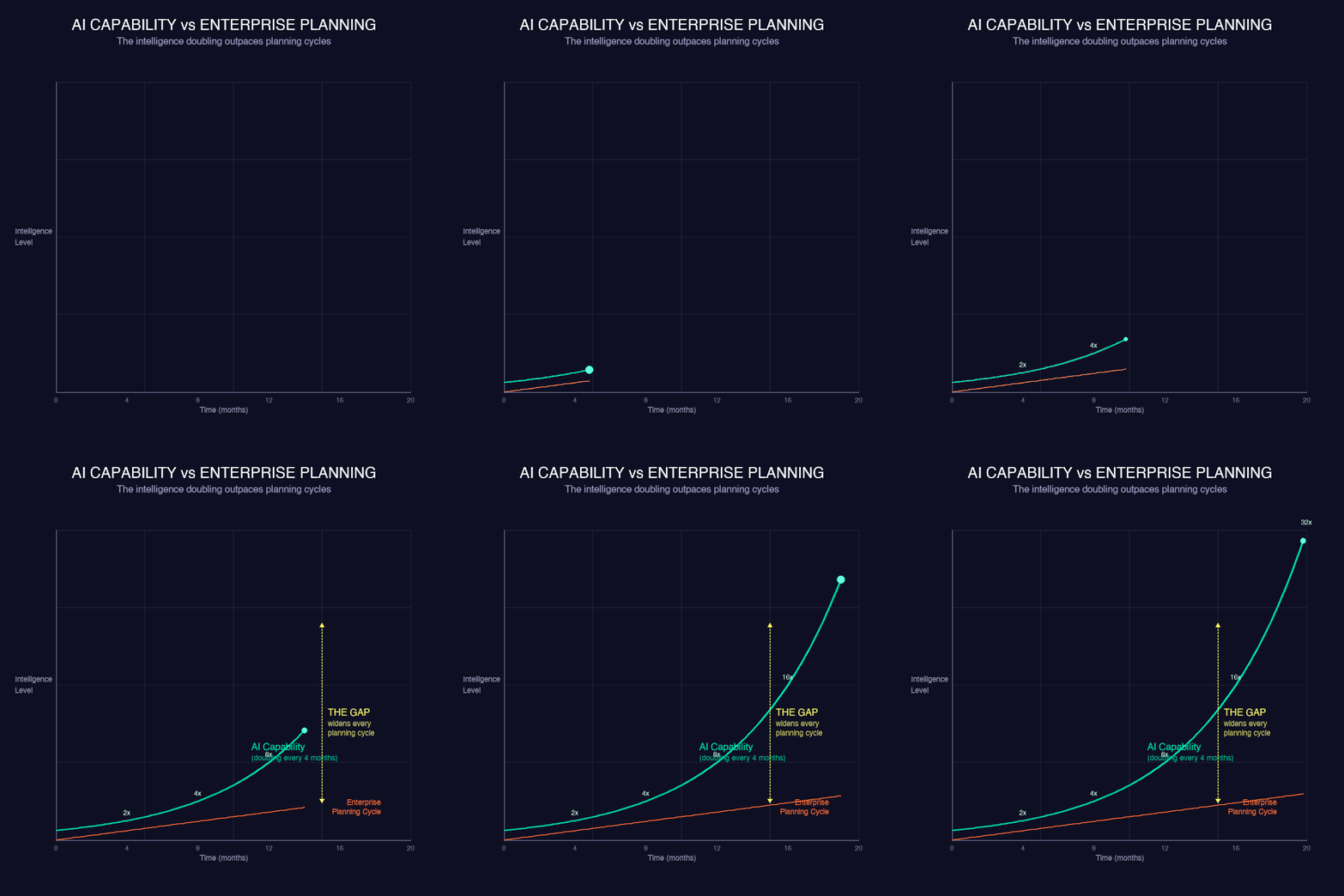
The intelligence of frontier model + harness on long-running tasks is doubling every 4 months.
That's faster than most enterprise planning cycles. In 16 months, you're 8X smarter. We perhaps need to think twice before betting against the exponential.
This isn't hype - it's a forcing function. If your AI roadmap assumes linear improvement, or if your validation cycles take longer than four months, you're designing for a world that no longer exists by the time you ship.
'Debt Paydown Is Cheap'
Here's a counterintuitive take that stopped me in my tracks: badly-factored but functionally correct AI-generated code is NOT real technical debt.
Why? A smarter model - advancing in months - can refactor it. The spec is preserved. Think of it as 'runaway inflation' - debt paydown gets cheaper by the day.
This reframes the entire legacy modernization conversation. The cost of messy code is no longer permanent. The cost of not moving is.
The Bitter Lesson (Again)
Every engineering trick you apply to juice performance at one model generation has a chance to become a liability at the next.
🔹 RAG chunking? Becoming less important as context windows grow.
🔹 Fine-tuned vertical models? A large multinational trained a specialized model that beat a leading model. Then the later version of the leading model arrived and 'walked away from it. They didn't even get close. Ever.'
Enterprise design principle: Build the thinnest possible wrappers. Let the model do its thing.
This is hard advice to follow when you're used to control. But the exponential rewards simplicity.
What This Means for Financial Services
Core banking migration. KYC automation. Fraud detection. These aren't 'AI projects' anymore - they're 'trust the transformation process' decisions.
The banks that move first will gain a step-change in development velocity that compounds. The ones that wait for perfect validation may find the system has changed again before they finish validating.
Somebody will go first.
I left that session thinking about the customers I work with - the ones wrestling with risk frameworks, the ones building business cases, the ones asking 'how do we know this is safe?' The answer isn't to slow down. It's to build harnesses that let you move fast and stay in control. To design for the exponential, not against it. 🚀
More soon. What's your take? 🙏
#AlwaysDay1 #AgenticAI #EnterpriseAI #AIArchitecture #FinancialServices #FrontierModels #DigitalTransformation
The views and opinions expressed in this post are my own and do not necessarily reflect those of my employer or any organisation I am affiliated with.